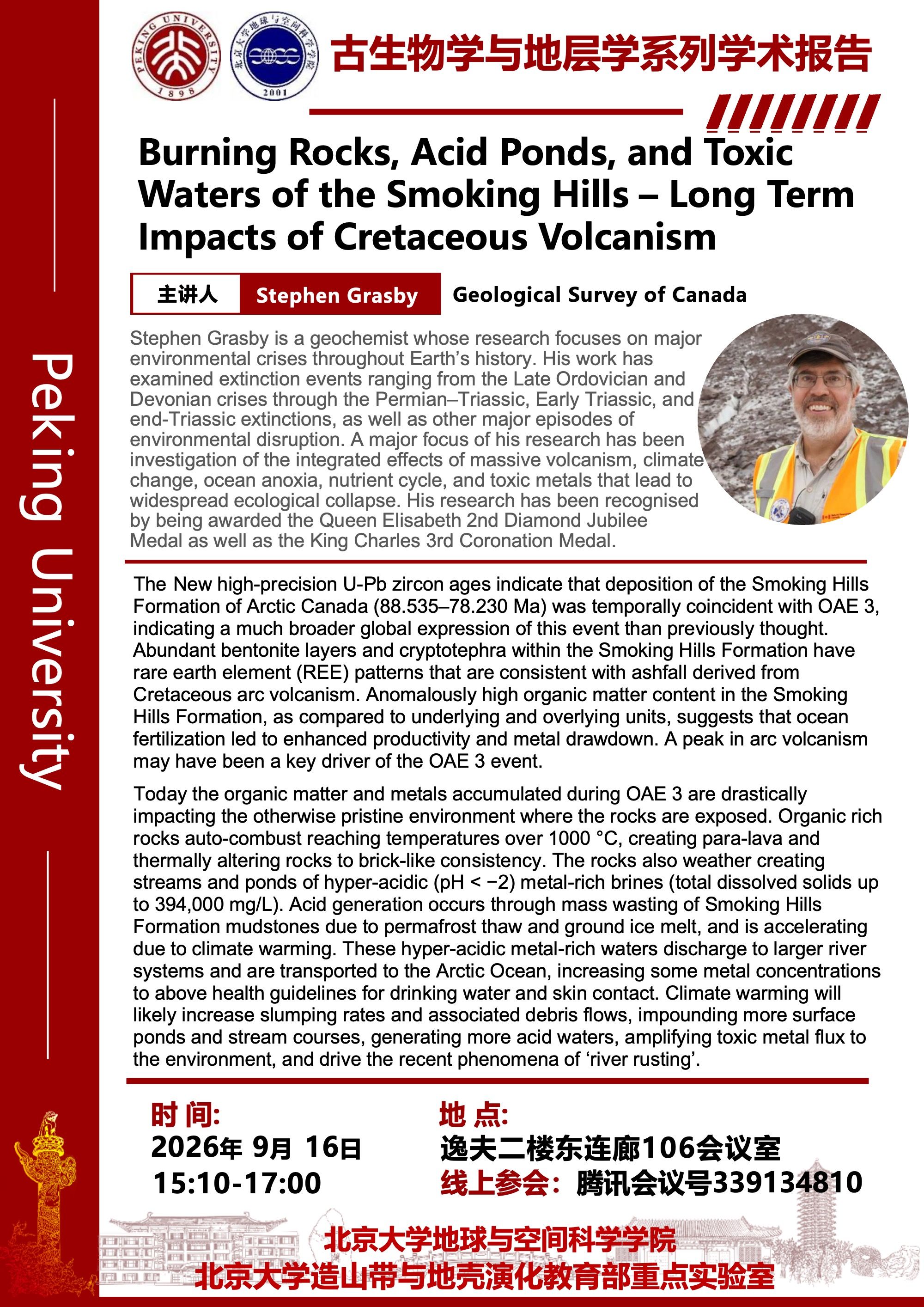
报告人:Stephen Grasby
职称:研究员,客座教授
单位:加拿大地质调查局,加拿大卡尔加里大学地球科学系
报告题目:
Burning Rocks, Acid Ponds, and Toxic Waters of the Smoking Hills – Long-term Impacts of Cretaceous Volcanism
报告介绍:
The New high-precision U-Pb zircon ages indicate that deposition of the Smoking Hills Formation of Arctic Canada (88.535–78.230 Ma) was temporally coincident with OAE 3, indicating a much broader global expression of this event than previously thought. Abundant bentonite layers and cryptotephra within the Smoking Hills Formation have rare earth element (REE) patterns that are consistent with ashfall derived from Cretaceous arc volcanism. Anomalously high organic matter content in the Smoking Hills Formation, as compared to underlying and overlying units, suggests that ocean fertilization led to enhanced productivity and metal drawdown. A peak in arc volcanism may have been a key driver of the OAE 3 event.Today the organic matter and metals accumulated during OAE 3 are drastically impacting the otherwise pristine environment where the rocks are exposed. Organic rich rocks auto-combust reaching temperatures over 1000 °C, creating para-lava and thermally altering rocks to brick-like consistency. The rocks also weather creating streams and ponds of hyper-acidic (pH<−2) metal-rich brines (total dissolved solids up to 394,000 mg/L). Acid generation occurs through mass wasting of Smoking Hills Formation mudstones due to permafrost thaw and ground ice melt, and is accelerating due to climate warming. These hyper-acidic metal-rich waters discharge to larger river systems and are transported to the Arctic Ocean, increasing some metal concentrations to above health guidelines for drinking water and skin contact. Climate warming will likely increase slumping rates and associated debris flows, impounding more surface ponds and stream courses, generating more acid waters, amplifying toxic metal flux to the environment, and drive the recent phenomena of "river rusting".Stephen Grasby is a geochemist whose research focuses on major environmental crises throughout Earth’s history. His work has examined extinction events ranging from the Late Ordovician and Devonian crises through the Permian–Triassic, Early Triassic, and end-Triassic extinctions, as well as other major episodes of environmental disruption. A major focus of his research has been investigation of the integrated effects of massive volcanism, climate change, ocean anoxia, nutrient cycle, and toxic metals that lead to widespread ecological collapse. His research has been recognised by being awarded the Queen Elisabeth 2nd Diamond Jubilee Medal as well as the King Charles 3rd Coronation Medal.
 首页
首页 登录
登录 English
 旧版网站
旧版网站